



DIY Season Color Analysis: Are You a Spring, Summer, Winter, or Fall?
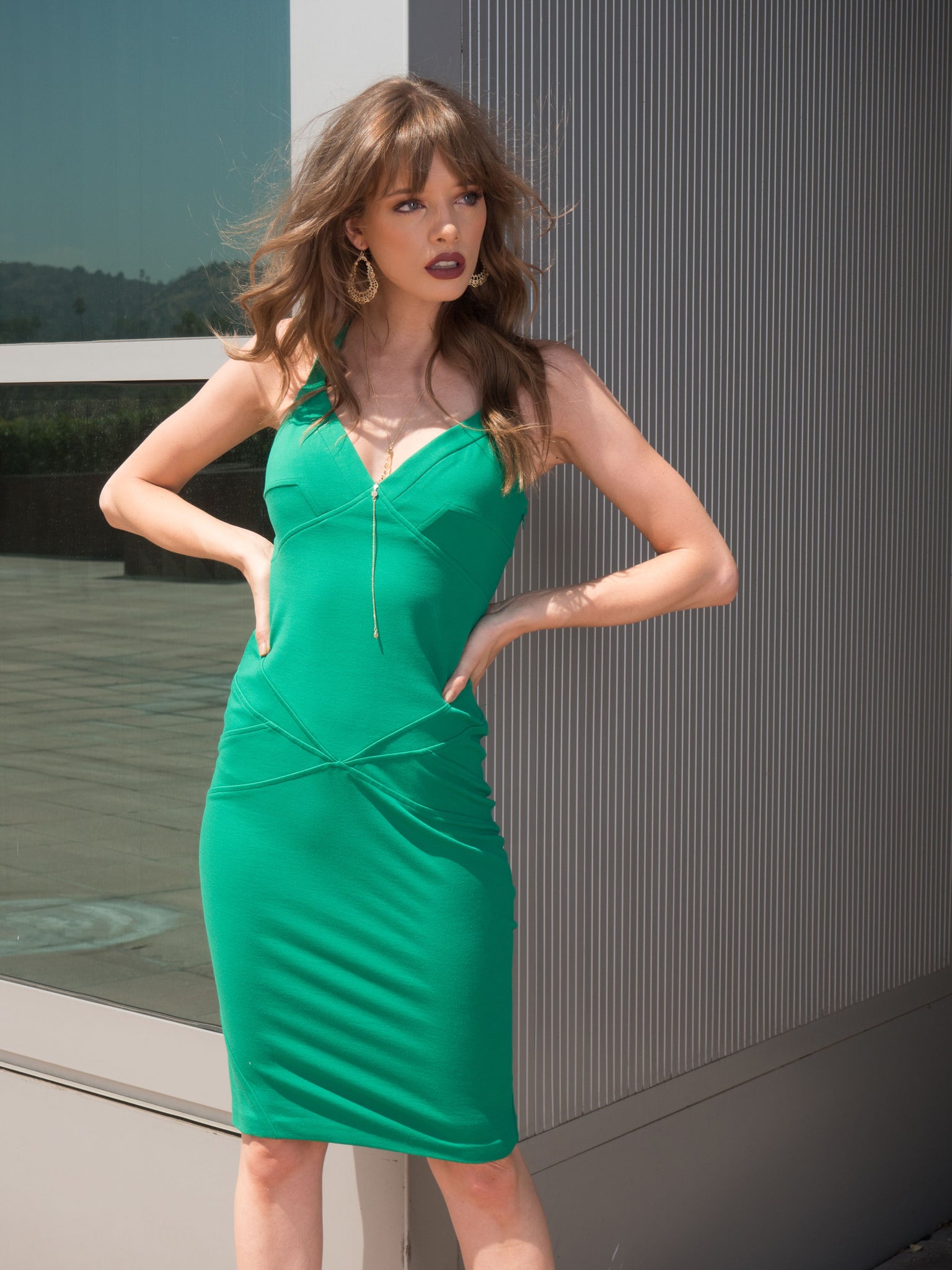
Which colors look best on you? Which colors make your skin glow, your eyes sparkle and your whole face look rested? A DIY color analysis answers exactly that. Seasonal color analysis sorts your natural coloring into one of four seasons (spring, summer, autumn or winter) and then into one of twelve sub-seasons, so you know which shades flatter you most. If you've ever typed what season am I into a search bar, grab a mirror. We're going to figure it out together, step by step, with a quick self-test and color swatches for every season.
I love this tool because it makes shopping so much easier. When you know your palette, you walk past the pieces that will sit in your closet and go straight to the ones you'll reach for every day. (And the pieces that never felt quite right? Those are perfect to consign with us so someone whose palette they do suit can love them!)
Why your season matters
Wearing colors that work with your natural coloring can lift your mood, your confidence and your sense of style. (There's real psychology behind that feeling, as we explored in our post on dopamine dressing.) Your season is a tool to help you choose the clothes, makeup and even hair colors that flatter you most.
What I particularly love about seasonal color analysis is that it starts with your natural beauty, highlighting what makes you uniquely you instead of squeezing anyone into a box. Dressing for your color season helps you curate a wardrobe or personal uniform that enhances that natural beauty. If you're looking for a gorgeous glow-up, a DIY seasonal color analysis is one of the easiest places to start.
Note: Think of your seasonal color palette as a tool, not a rule. It shows you which colors, shades and patterns look most flattering near your face, but you're always free to wear whatever makes you happy!
How seasonal color analysis works
Color analysis borrows the seasons because we already link them with certain colors. We picture deep, warm reds, rusts and browns when we think of the rich colors of fall. Winter brings to mind winter white, icy blue and royal purple. Spring is fresh greens, corals and warm, clear brights. And summer is soft and hazy: powder blue, lavender and dusty rose.
Your skin, hair and eye color work together to place you in a season. We'll look at three qualities of your coloring:
- Hue (undertone): warm, cool or neutral
- Value: how light or deep your overall coloring is, and how much contrast there is between your hair, eyes and skin
- Chroma: whether your coloring reads bright and clear or soft and muted
The original system had just four seasons. Most analysts today use the 12-season system, which splits each season into three, based on which quality is strongest in your coloring:
- Winter (cool and clear): Deep Winter, True (Cool) Winter, Bright (Clear) Winter
- Spring (warm and clear): Light Spring, True (Warm) Spring, Bright (Clear) Spring
- Summer (cool and soft): Light Summer, True (Cool) Summer, Soft Summer
- Autumn (warm and soft or rich): Soft Autumn, True (Warm) Autumn, Deep Autumn
You'll see "Bright" and "Clear" used for the same sub-seasons, and "Deep" and "Dark" too. They mean the same thing.
Before you start: set up for an accurate read
Lighting changes everything, so set yourself up for success:
- Use natural daylight. Stand facing a window on a bright, overcast day if you can. Warm lamps, fluorescent bulbs and colored walls all throw color onto your skin.
- Go bare-faced. Skip makeup, self-tanner and tinted moisturizer.
- Pull your hair back (and cover it with a white towel if it's colored, so it doesn't sway the result).
- Grab a mirror and your phone. Photos side by side make comparisons much easier than your memory.
- Gather fabrics to drape: something bright white, something cream or ivory, a gold and a silver piece of jewelry, and a few colored tops, scarves or towels.
- Take your time. Look at your skin, not the fabric. The right color makes your skin look even and your eyes bright; the wrong one shows up first as shadows, redness or a gray cast.
Step 1: Find your undertone (warm, cool or neutral)
The first part of your color analysis is your hue, also called your skin's undertone. It tells you whether warm or cool colors flatter you more. Your undertone is different from your surface skin tone: someone with very fair skin and someone with deep skin can both be warm, cool or neutral.
Take the tests below and keep a tally of how many A's and B's you get. The first three are the most telling; the last two are helpful tie-breakers.
The white paper (or white fabric) test
Hold a piece of bright white printer paper or fabric under your chin. It should be true white, not ivory. Stand in natural light with no makeup.
- A: My skin looks yellow, golden or peachy next to the white.
- B: My skin looks pink, rosy or slightly bluish next to the white.
The jewelry and metal test
In natural light, hold gold and silver against your skin. Thicker bracelets or necklaces make the comparison easier. Try to be objective rather than picking the metal you already wear most. (For more on pairing metals, see the art of matching accessories.)
- A: Gold makes my skin look more even, healthy and glowing.
- B: Silver makes my skin look more even, healthy and glowing.
The drape test: orange vs. magenta
In the same light, hold up something bright orange and take a photo. Then do the same with something bright magenta or fuchsia. Compare the photos side by side.
- A: I look better next to the orange.
- B: I look better next to the magenta.
The vein test
Turn your hand over and look at the veins on your inner wrist. This is the best-known test, but it's also the least reliable, because how veins look depends on lighting and skin thickness. Count it only as a hint.
- A: My veins look mostly green or olive.
- B: My veins look mostly blue or purple.
The sun test
Which sounds most like you? Skip this one if any medication or condition affects how your skin reacts to the sun, and remember it's only a loose clue.
- A: I tan more easily than I burn.
- B: I burn more easily than I tan.
Your undertone results
- Mostly A's: you likely have a warm undertone, which points to spring or autumn.
- Mostly B's: you likely have a cool undertone, which points to summer or winter.
- A near-even split (or answers you couldn't decide): you may be neutral. Neutrals usually land in one of the "in-between" sub-seasons: Soft Summer or Soft Autumn, Light Spring or Light Summer, Deep Autumn or Deep Winter, Bright Spring or Bright Winter. Steps 2 and 3 will tell you which.
What about olive skin? Olive describes a greenish cast that sits on top of your undertone, and it can show up with warm, cool or neutral undertones. Olive skin is often misread as cool in the vein test, so lean on the white paper and drape tests instead. Many olive complexions turn out to be Soft or Deep Autumn, or Deep Winter.
If you have a warm undertone…
- Your skin has a golden, peachy or bronze glow.
- You often have lower contrast between your skin, eyes and hair.
- Your eyes may be hazel, amber, warm brown, warm green or turquoise.
- Your natural hair may be golden blonde, strawberry blonde, red, auburn, caramel, chestnut or a rich golden brown.
If you have a cool undertone…
- Your skin has a pink, rosy or blue-ish cast.
- You may have moderate to high contrast between your features.
- Your eyes may be gray, blue, gray-green, cool brown or black-brown.
- Your natural hair may be ash blonde, ash brown, dark brown, black, or silver.
Step 2: Check your value and contrast (light or deep?)
Value is the light-to-dark quality of your coloring, plus how much contrast there is between your hair, eyes and skin. Your undertone came from your skin; now look at your hair and eyes. A quick trick: take a photo of your face and turn it black-and-white. Does your face read mostly light, medium or deep? Do your hair and eyes stand out sharply from your skin or blend softly?
Warm: spring or autumn?
Spring and autumn both have warm undertones. The difference is depth and clarity: springs are lighter and brighter, with a fresh, sunny look, while autumns are richer, deeper or softer, with a golden, earthy look.
- Spring: light to medium coloring, warm, clear and bright, low to medium contrast
- Autumn: medium to deep coloring, warm, rich or muted, low to medium contrast
Spring examples
- Hair: golden or strawberry blonde to light golden brown
- Eyes: clear blue, aqua, turquoise, bright green, light golden hazel or light brown
Autumn examples
- Hair: medium to deep brown, auburn, copper or deep red, with golden or red tones
- Eyes: hazel, amber, olive or warm green, warm medium to dark brown
Cool: winter or summer?
Winter and summer both have cool undertones, but winter usually has higher contrast and deeper, more saturated coloring, while summer is lighter and softer. Winters look best in deep, pure, vivid colors; summers look best in lighter, softer, slightly grayed colors.
- Winter: dark hair, striking eyes, high contrast, saturated colors
- Summer: lighter or ashier hair, soft eyes, low to moderate contrast, muted colors
Winter examples
- Hair: dark ash brown to black with cool tones (or bright silver)
- Eyes: dark brown to black-brown, icy or vivid blue, cool green, gray-blue
Summer examples
- Hair: ash blonde to ash or mousy medium brown
- Eyes: soft blue, gray-blue, gray-green, gray-brown, slate
Step 3: Check your chroma (bright and clear or soft and muted?)
Chroma is how saturated a color is. In color analysis, it describes whether your coloring looks crisp and vivid or soft and blended. Hold a bright, pure color (like a cobalt or kelly green top) next to your face, then a dusty, grayed version (like slate blue or sage).
- Bright/clear: the vivid color makes your eyes pop and your skin look clean. Your eyes are often your most striking feature. Think Bright Spring or Bright Winter.
- Soft/muted: the vivid color seems to wear you, while the dusty one looks elegant and harmonious. Think Soft Summer or Soft Autumn.
- Somewhere in the middle: your undertone or your depth is the strongest thing about you, so you're likely a True, Light or Deep sub-season.
Quick self-test: what season am I?
Grab a pen and answer each question with the letter that fits you best. Go with your first instinct, and judge your natural hair color (or what it was before you started coloring it).
-
Which white looks best right under your face?
A. Warm ivory that looks fresh and bright
B. Soft white, not stark
C. Cream or oatmeal
D. Crisp, pure optic white -
Which metal looks best against your skin?
A. Shiny yellow gold or rose gold
B. Brushed silver, white gold or pewter
C. Antique gold, bronze or copper
D. High-shine silver or platinum -
What's your natural hair color?
A. Golden or strawberry blonde to light golden brown
B. Ash blonde to ash or mousy brown
C. Auburn, copper, chestnut or deep golden brown
D. Dark brown or black (or bright silver) -
What color are your eyes?
A. Clear warm blue, aqua, bright green or light golden brown
B. Soft blue, gray-blue, gray-green or soft hazel
C. Hazel, amber, olive green or warm brown
D. Dark brown, black-brown, or icy or vivid blue or green -
How much contrast is there between your hair, eyes and skin?
A. Medium, with a bright, lively look
B. Low to medium, soft and blended
C. Low to medium, rich and warm
D. High and striking -
Which lipstick looks most natural on you?
A. Coral or warm peachy pink
B. Rose, mauve or soft berry
C. Brick, terracotta or warm brown-red
D. Blue-red, fuchsia or deep berry -
How do you look in black near your face?
A. Heavy; I prefer navy or camel
B. Harsh; I prefer charcoal or soft navy
C. Draining; I prefer chocolate brown or olive
D. Fantastic, sharp and polished -
Which colors get you the most compliments?
A. Coral, turquoise and warm pastels
B. Lavender, powder blue and dusty rose
C. Rust, olive, mustard and camel
D. Cobalt, emerald, fuchsia, and black and white
Your self-test results
- Mostly A's: Spring. Warm, clear and luminous. Jump to Spring and compare Light, True and Bright Spring.
- Mostly B's: Summer. Cool, soft and gentle. Jump to Summer and compare Light, True and Soft Summer.
- Mostly C's: Autumn. Warm, rich and earthy. Jump to Autumn and compare Soft, True and Deep Autumn.
- Mostly D's: Winter. Cool, deep and vivid. Jump to Winter and compare Deep, True and Bright Winter.
Split between two letters? That's great information, because it points straight to your sub-season:
- A and B: you're light first. Compare Light Spring and Light Summer.
- B and C: you're soft first. Compare Soft Summer and Soft Autumn.
- C and D: you're deep first. Compare Deep Autumn and Deep Winter.
- A and D: you're bright first. Compare Bright Spring and Bright Winter.
- A and C: you're warm first. Compare True Spring and True Autumn.
- B and D: you're cool first. Compare True Summer and True Winter.
Then drape the best colors from each of your two candidate palettes below and see which ones make your skin look smoothest. That's your season!
A note on the celebrity examples below: they're educated guesses from photos, and lighting, hair color and makeup can change how anyone reads, so use them for inspiration rather than as rules.
Winter: cool, deep and vivid
Winters have cool or neutral-cool undertones and the highest contrast of any season: think dark hair with fair skin, or deep skin with bright, clear eyes. You shine in pure, saturated colors and crisp black and white, while dusty or earthy shades can make you look tired.
Best winter colors
True red
#C8102EFuchsia
#D1157FCobalt
#0047ABEmerald
#00916ERoyal purple
#5B2C83Icy pink
#F4D7E6
Best neutrals: black, pure white, charcoal and deep navy.
Black
#000000Pure white
#FFFFFFCharcoal
#36454FDeep navy
#1F2A44
Metals: silver, platinum and white gold.
Colors to skip near your face: camel, orange, mustard, rust, and dusty, grayed pastels.
Deep Winter (Dark Winter)
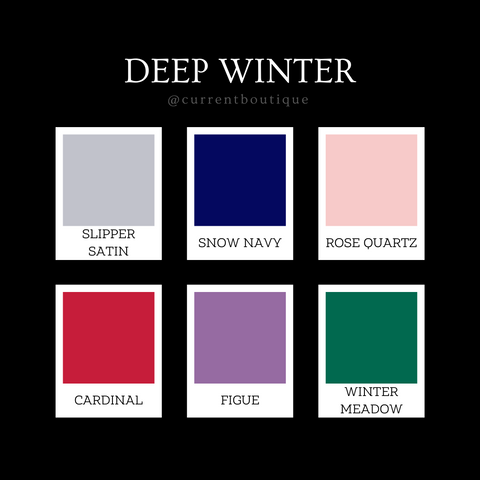
Deep is your strongest quality, with cool coming second. You likely have medium-brunette to black hair and dark eyes, and lighter colors can make you look washed out. Choose intense, deeply pigmented jewel tones (burgundy, emerald, sapphire, deep plum) and strong neutrals like black, charcoal and midnight navy. "Deep" means rich pigment, not necessarily dark: a vivid fuchsia or icy accent works beautifully against all that depth. If you love a pastel, wear it away from your face or pair it with a bold accessory.
Celebrity examples of deep winter
Sandra Bullock, Kim Kardashian, Demi Moore, Penélope Cruz, Catherine Zeta-Jones, Mila Kunis, Viola Davis, Lana Parrilla, Nina Dobrev, Gong Li, Salma Hayek, Gal Gadot, Uzo Aduba, Linda Cardellini, Shay Mitchell, Mindy Kaling, Keira Knightley, Priyanka Chopra Jonas, Octavia Spencer.
True Winter (Cool Winter)
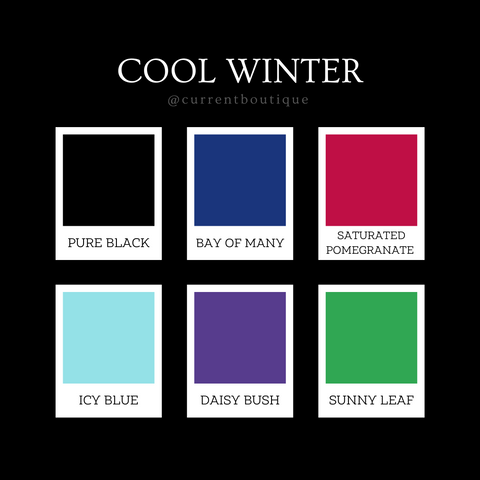
Cool is your strongest quality. You have the classic winter look with crisp, high-contrast features and a rosy or blue-ish cast to your skin. Reach for blue-based colors: true red, raspberry, magenta, royal blue, pine green and icy pastels. Pure white looks better on you than off-white, and black is one of your best friends.
Celebrity examples of true winter
Selena Gomez, Janelle Monáe, Brooke Shields, Kendall Jenner, Christina Ricci, Jenna Dewan, Katy Perry, Victoria Justice, Liv Tyler, Anne Hathaway, Jameela Jamil, Zooey Deschanel, Amal Clooney, Lauren Graham, Jada Pinkett Smith.
Bright Winter (Clear Winter)

Clarity is your strongest quality, with cool coming second. Does your face look high-contrast in the mirror, with jewel-like eyes (bright blue, steel gray, vivid green or bright hazel) as your most striking feature? Snow White is the classic example. Wear clean, saturated "true" colors, pure white, black and true gray, and try one bold color or a sharp light-dark mix. Muted, dusty colors will dull your sparkle.
Celebrity examples of bright (clear) winter
Megan Fox, Tina Fey, Alexis Bledel, Olivia Munn, Danai Gurira, Courteney Cox, Camila Mendes, Krysten Ritter, Maria Borges.

Pictured: our Halston Heritage cobalt blue dress (size 0), a perfect winter blue. Every piece we carry is one of a kind, so if it has found a new home, browse Bold Hues for more in this color family.

Pictured: our Rebecca Taylor fuchsia strapless belted dress (size 4). Every piece we carry is one of a kind, so if it has found a new home, browse Bold Hues for more in this color family.
Spring: warm, light and clear
Springs have warm or neutral-warm undertones and a fresh, sunny clarity. Your coloring is light to medium, with eyes that often look bright and sparkly. Clear, warm colors make you glow, while heavy black, icy shades and dusty tones can look harsh or flat on you.
Best spring colors
Coral
#FF7F50Warm turquoise
#30C9C0Golden yellow
#F6C343Apple green
#7DC242Peach
#FFCBA4Poppy red
#E3492B
Best neutrals: camel, ivory, warm beige and a bright, warm navy.
Camel
#C19A6BIvory
#FFF8E7Warm beige
#E3C9A6Warm navy
#3A4E7A
Metals: yellow gold, rose gold and polished brass.
Colors to skip near your face: black, burgundy, icy pastels, and dusty, grayed colors.
Light Spring
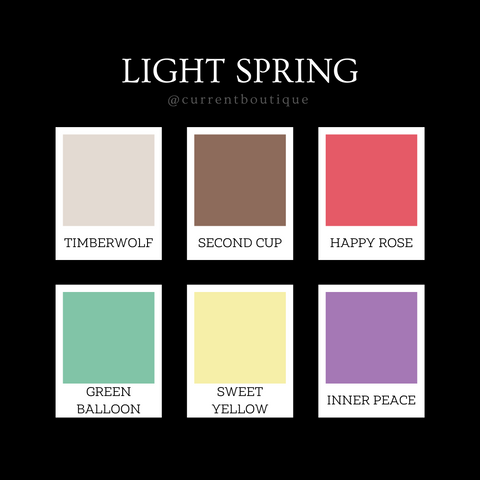
Light is your strongest quality, with warm coming second. You likely have blonde or light golden-brown hair and light blue, aqua or green eyes, and heavy colors make your face look shadowed. Wear light, warm, clear shades: peach, butter yellow, light aqua, warm pink and soft coral. Choose ivory or soft white over stark white, and swap black for light camel, stone or a light warm navy. If you love black, keep it away from your face and add a bright scarf or gold jewelry.
Celebrity examples of light spring
Amanda Seyfried, Renée Zellweger, Scarlett Johansson, Gillian Jacobs, AnnaSophia Robb, Elizabeth Banks, Jessica Chastain, Gigi Hadid, Taylor Swift, Kate Hudson, Jennifer Lawrence, Dakota Fanning.
True Spring (Warm Spring)
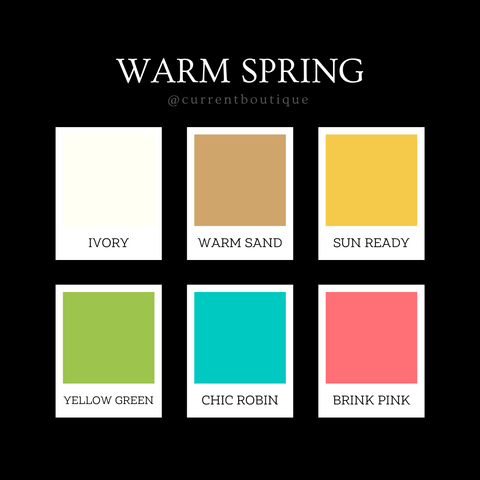
Warm is your strongest quality. You may have golden blonde, strawberry blonde or golden-brown hair, green, topaz or light brown eyes, and ivory, golden-beige or bronze skin. Choose yellow-based colors: coral, apricot, golden yellow, warm green, poppy red and warm turquoise. Camel, warm browns and ivory are your neutrals, and cool, blue-based colors will fight your glow.
Celebrity examples of true spring
Blake Lively, Hayden Panettiere, Cameron Diaz, Meg Ryan, Nicole Kidman, Amy Adams, Goldie Hawn, Amy Schumer, Kristen Bell, Sadie Sink, Jane Krakowski, Leslie Mann.
Bright Spring (Clear Spring)
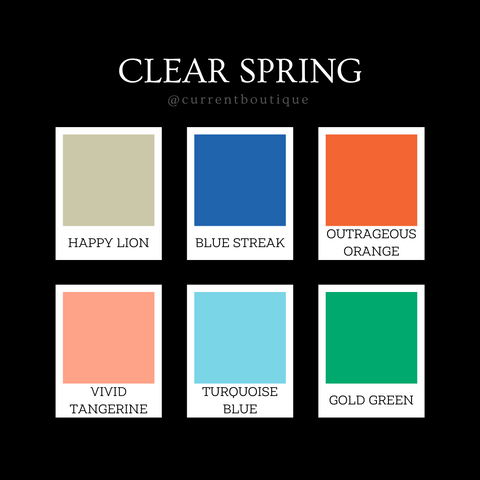
Clarity is your strongest quality, with warm coming second. You have bright eyes and noticeable contrast, but with a warmer, sunnier feel than a Bright Winter. Wear vivid, clear colors (hot coral, bright turquoise, kelly green, warm violet) and mix light and dark for contrast. Pure white works for you, and you're the spring who can carry a touch of black. Avoid muted, dusty shades.
Celebrity examples of bright (clear) spring
Zoe Saldaña, Brittany Snow, Milla Jovovich, Emma Stone, Kim Cattrall, Vanessa Hudgens, Tessa Thompson, Michelle Dockery, Rebel Wilson, Demi Lovato, Miranda Cosgrove, Julianne Hough, Gina Rodriguez, Kerry Washington.

Pictured: our Trina Turk coral pencil skirt (size 2). Every piece we carry is one of a kind, so if it has found a new home, browse Bold Hues for more in this color family.

Pictured: our Trina Turk turquoise pencil skirt (size 2). Every piece we carry is one of a kind, so if it has found a new home, browse Bold Hues for more in this color family.
Summer: cool, light and soft
Summers have cool or neutral-cool undertones and soft, blended coloring, often with ash-toned hair and gray-blue, gray-green or soft hazel eyes. Gentle, slightly grayed colors make you look elegant and rested, while high-voltage brights, orange and harsh black can overpower you.
Best summer colors
Powder blue
#B0C4DELavender
#B4A7D6Dusty rose
#D8A7B1Soft raspberry
#B3446CSeafoam
#9FD8CBPeriwinkle
#8E9CD4
Best neutrals: soft white, dove gray, rose-taupe and slate navy.
Soft white
#F5F5F0Dove gray
#A9A9B0Rose taupe
#8B8589Slate navy
#3F4E6B
Metals: silver, white gold and pewter (brushed finishes are lovely on you).
Colors to skip near your face: orange, mustard, rust, neon brights and stark black.
Light Summer
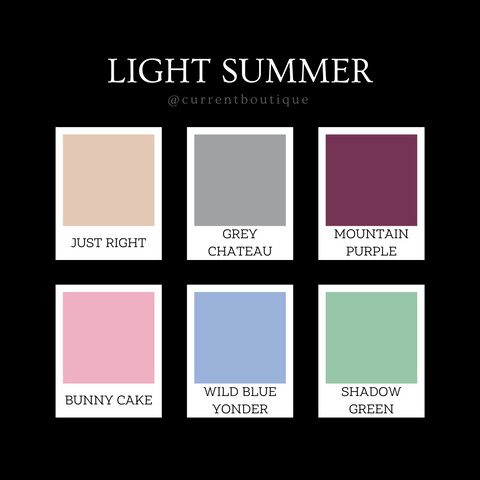
Light is your strongest quality, with cool coming second. You likely have light ash-blonde or light brown hair, light blue, blue-gray or aqua eyes, and fair skin. Wear light, cool, gentle colors: sweet-pea lavender, powder blue, pastel pink, soft aqua and light periwinkle. Soft white beats pure white, and your neutrals are light gray, pewter, stone and light navy. If you wear black, keep it away from your face and add a soft scarf or silver jewelry to bring back the light.
Celebrity examples of light summer
Michelle Pfeiffer, Gwyneth Paltrow, Jodie Foster, Reese Witherspoon, Amy Poehler, Kirsten Dunst, Naomi Watts, Margot Robbie, Princess Diana, Cate Blanchett, Blythe Danner.
True Summer (Cool Summer)
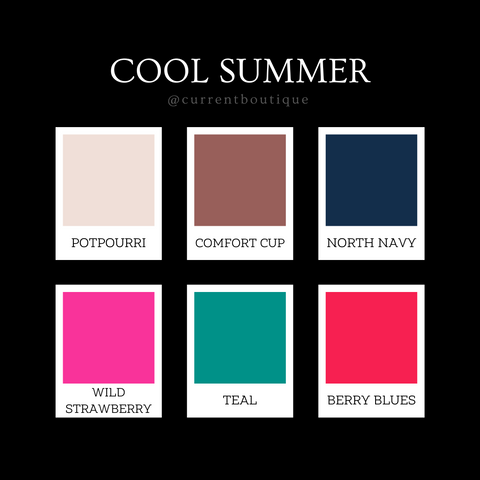
Cool is your strongest quality. You may have light-to-medium ash brown hair (maybe a few red highlights, but cool overall), blue, gray-blue, green or rosy-brown eyes, and rose-beige skin with pink undertones. Reach for blue-based, medium-soft colors: rose, raspberry, cornflower blue, lavender, cool jade and soft plum. Your neutrals are blue-gray, cool taupe and navy, and warm shades like salmon, orange, moss and ginger will look off.
Celebrity examples of true summer
Olivia Wilde, Emily Blunt, Allison Williams, Megan Boone, Anna Kendrick, Joey King, Alison Brie, Jennifer Garner.
Soft Summer
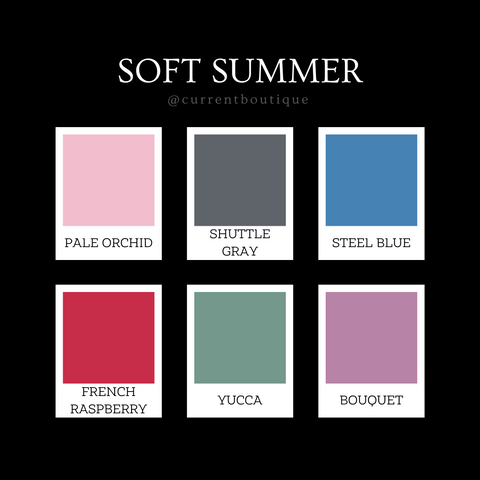
Soft is your strongest quality, with cool coming second. Your coloring is medium (not very light, not very dark) and blended, with little contrast between hair, skin and eyes. I love this palette because it's so elegant. Wear muted, cool shades: dusty rose, mauve, slate blue, sage, soft teal and faded denim. You look stunning in tonal and monochrome outfits. Charcoal, soft white and rose-brown are your neutrals; stark black and white are too harsh.
Celebrity examples of soft summer
Sarah Jessica Parker, Miley Cyrus, Lorde, Bella Hadid, Jennifer Aniston, Kate Middleton, Dakota Johnson, Katie Holmes, Rachel McAdams, Maisie Williams, Maggie Gyllenhaal, Emilia Clarke, Cobie Smulders, Kristen Stewart.

Pictured: our Lela Rose lavender sheath dress with silver appliqué (size 6). Every piece we carry is one of a kind, so if it has found a new home, browse Bold Hues for more in this color family.

Pictured: our Veronica Beard dusty rose "Rory" shirt dress (size 6). Every piece we carry is one of a kind, so if it has found a new home, browse Bold Hues for more in this color family.
Autumn (Fall): warm, rich and earthy
Autumns have warm or neutral-warm undertones and a golden, earthy richness. Your coloring ranges from soft and medium to deep, often with auburn, chestnut or golden-brown hair and hazel, amber, olive or warm brown eyes. Rich, warm colors make you glow, while icy pastels, fuchsia and stark white can make you look pale.
Best autumn (fall) colors
Rust
#B7410EOlive
#708238Mustard
#D4A017Deep teal
#2F6F73Terracotta
#C96A4ABrick red
#7B2D26
Best neutrals: chocolate brown, camel, cream and khaki.
Chocolate
#5C4033Camel
#C19A6BCream
#F3E5C4Khaki
#9C8B6E
Metals: yellow gold, antique gold, bronze and copper.
Colors to skip near your face: icy pastels, fuchsia, cobalt, pure white and stark black.
Soft Autumn
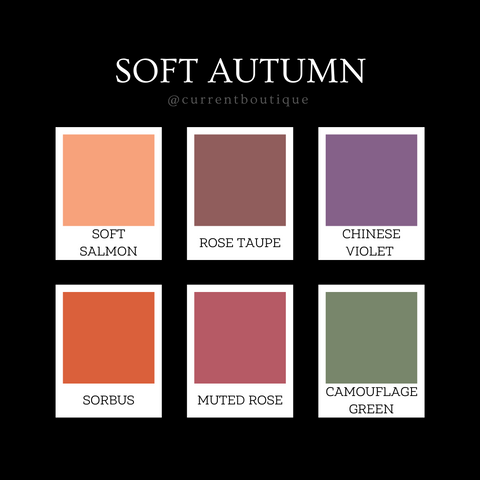
Soft is your strongest quality, with warm coming second. Your coloring is medium and blended, with little contrast. Choose muted, warm shades: sage, moss, soft teal, salmon, dusty peach and warm taupe. Monochrome outfits and washed or faded fabrics (denim, moss, jade) look effortless on you. Your neutrals are camel, soft cocoa, olive and warm gray; skip pure white and black near your face.
Celebrity examples of soft autumn
Meryl Streep, Drew Barrymore, Tyra Banks, Kate Winslet, Angelina Jolie, Adele, Nicole Richie, Elizabeth Olsen, Kate Moss, Jessica Biel, Mariah Carey, Priscilla Presley, Victoria Pedretti.
True Autumn (Warm Autumn)
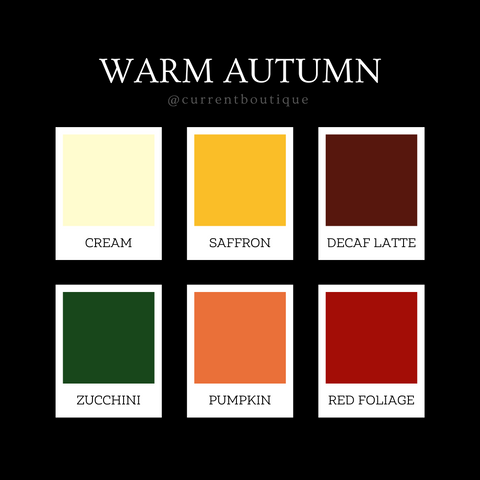
Warm is your strongest quality. You may have auburn, copper or golden-brown hair, hazel, amber or warm brown eyes, and golden-beige to bronze skin. Wear the colors of a fall forest: pumpkin, rust, mustard, olive, moss, warm teal and deep periwinkle. Camels, browns and warm grays are your neutrals, and cream and ivory beat bright white. For this season's take on these shades, see our Fall 2026 color report.
Celebrity examples of true autumn
Beyoncé, Jennifer Lopez, Shailene Woodley, Eva Marcille, Isla Fisher, Julianne Moore, Bernadette Peters, Aishwarya Rai, Jennifer Stone, Diane Lane, Sheryl Crow, Lindsay Lohan, Jenna Fischer.
Deep Autumn (Dark Autumn)
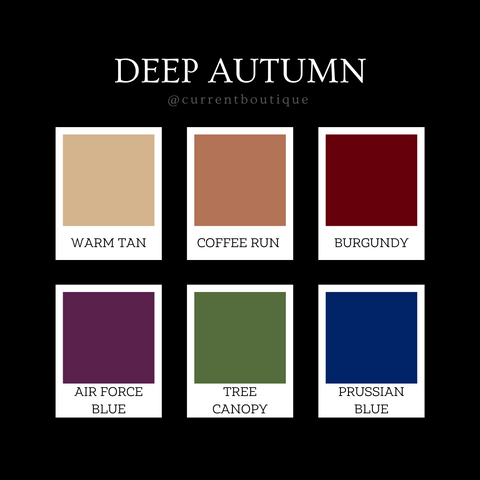
Deep is your strongest quality, with warm coming second. You likely have medium to deep brown or black hair (or dark auburn) and dark brown or deep hazel eyes, and pale colors leave you looking washed out. Choose intense, warm, deeply pigmented colors: burgundy, tomato red, forest green, deep teal, aubergine and bronze. Chocolate, espresso and deep olive are your neutrals, and unlike other autumns, you can handle black. Pick bright, warm accessories near your face if you wear a lighter color.
Celebrity examples of deep autumn
Rashida Jones, Oprah Winfrey, Sofía Vergara, Jessica Alba, Eva Mendes, Julia Roberts, Sigourney Weaver, Meghan Markle, Freida Pinto, Natalie Portman, Zendaya, Lady Gaga, Lucy Hale, Minka Kelly, Halle Berry, Angela Bassett, Hilary Swank, Gabrielle Union, Aubrey Plaza.

Pictured: our See by Chloé mustard yellow silk ruffle dress (size 6). Every piece we carry is one of a kind, so if it has found a new home, browse Bold Hues for more in this color family.

Pictured: our Trina Turk olive strapless dress (size 6). Every piece we carry is one of a kind, so if it has found a new home, browse Bold Hues for more in this color family.
How to build a palette wardrobe on consignment
Now for the fun part: shopping! Your palette is the best shopping list you'll ever have. A few of my favorite ways to use it:
- Start near your face. Tops, scarves, jackets and necklaces matter most. Pants, skirts and shoes can wander outside your palette.
- Get your neutrals right first. Swapping black for navy, or bright white for ivory, changes your whole wardrobe. Our guide to finding and wearing your perfect neutral walks you through it.
- Coordinate your lipstick. Match your makeup to your palette with our tips on matching your lipstick to your clothes.
- Play with combinations. Once you know your colors, try a few unexpected color combos, or go bold with color blocking in your season's shades.
- Add color gradually. If you live in neutrals, our post on adding more color to your wardrobe makes it easy.
- Build a capsule. A palette makes every piece work together. See how to build the perfect fall/winter capsule wardrobe.
- Invest in quality. Preloved designer pieces let you buy beautiful fabrics in your exact shades for less. Here's how to spot high-quality pieces when shopping.
Shop our Bold Hues collection for vivid winter and spring brights, browse what’s just in, or search our full designer clothing collection by color. New to consignment? Here's everything you need to know about shopping consignment for the first time. And once you know your colors, pair them with your style personality using our 2026 fashion aesthetic quiz or guide to finding your personal style.
What season am I if I have dark hair and light eyes?
Dark hair with light, bright eyes (blue, gray or green) and fair skin is the classic high-contrast look, which usually points to Winter, most often True or Bright Winter. If your skin has a golden cast and your eyes are a warm green or aqua, compare Bright Spring too. A few other common combinations: red or auburn hair almost always lands in Spring or Autumn (bright and light means Spring; rich, deep or muted means Autumn); ash blonde hair with gray-blue eyes often means Summer; and dark hair, dark eyes and deep skin usually points to Deep Winter or Deep Autumn, depending on your undertone.
Can your color season change?
Your undertone doesn't change, so most color analysts consider your season stable for life. What can change is your value and contrast: going gray, coloring your hair, or a deep tan can shift which part of your palette looks best. A Deep Winter with silver hair, for example, may lean toward her lighter, icier shades. If your hair changes dramatically, it's worth re-draping your favorites.
What's the difference between warm and cool undertones?
Warm undertones have a golden, peachy or yellow cast, and look best in yellow-based colors and gold jewelry. Cool undertones have a pink, rosy or blue-ish cast, and look best in blue-based colors and silver. Neutral undertones sit in between and can borrow from both, as long as the colors aren't too extreme in either direction.
Do I need a professional color analysis?
Not to get started! A careful DIY seasonal color analysis in good daylight gets most people to the right season, or very close. A professional analyst drapes dozens of calibrated fabrics in controlled lighting, which helps if you're stuck between two neighboring seasons (like Soft Summer and Soft Autumn) or simply want an expert eye. Either way, trust what you see in the mirror: the colors that make your skin look smooth and your eyes bright are your colors.
What colors look good on everyone?
Stylists often point to colors that sit in the middle of the warm-cool and bright-soft range, because they don't push too far in any direction. Medium teal, a soft true red, eggplant, soft white and a medium navy are good examples. They're easy gifts, easy group-outfit colors, and a safe place to start if you're between seasons.
Which seasonal color palette are you?
If you're still not sure, ask a friend to help. A second set of eyes is surprisingly useful, especially for the drape test. Or come see us in person! Our stylists at our Georgetown, 14th Street, Clarendon and Old Town Alexandria boutiques love helping you try on colors in good light.
Understanding your seasonal color palette is one of the simplest ways to look and feel your best. Next time you shop, try on your palette and notice how much better you feel in the dressing room! Shop our newest arrivals in your season's colors, and if your closet is full of shades that aren't you, consign them with us. They'll be someone else's perfect color.
XOXO,
Carmen
Photo sources
Header image and season palette graphics: Craving Current archive (original 2022 post). Product photos: Current Boutique.
-

Valentino - Black Bow Front Blazer Sz 6
US$968.99 -

-

Chanel - Gold CC Logo Necklace
US$798.99 -


Carmen Lopez, President & CEO www.currentboutique.com

Hello Fashion Lovers! I've been in the fashion industry for nearly 20 years.
I started Current Boutique with the desire to recycle amazing pre-loved designer gems for others to enjoy! I value quality, unique craftsmanship, sustainability & saving money.
I am a fashion lover who is energized by the challenges and rewards of being an entrepreneur. I'm here to share tips on fashion, style, bargain shopping and business.
I hope you enjoy!
XOXO, Carmen

